My NEW favorite tool for assessing behavior (RIP, ACT Matrix)
The choice point is my new favorite tool for looking at and categorizing our behavior. I previously was using the ACT Matrix but this was often times confusing and overcomplicated. Choice point is super simple. It was created by my favorite ACT guru, Russ Harris. Think of it as the roadmap (whereas your values are the compass).
I’m going to break it down into smaller sections for the sake of explaining.
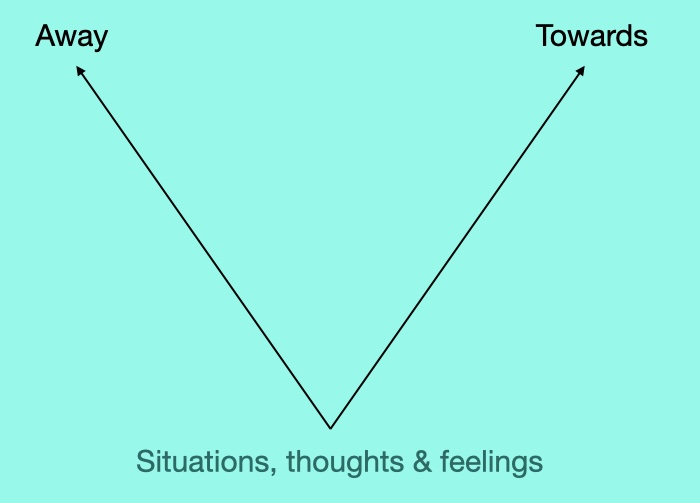
Throughout the day, we are going to face difficult situations, thoughts, and feelings. We have two different paths we can take. We can choose towards moves or away moves.
Towards moves are the things you want to continue doing, start doing, or do more of to get your life going in the direction you want it to be going in (refer to the compass—i.e. values).
Away moves are things that take us away from the the sort of person we want to be. These are the things you would like to decrease or stop altogether.
We ALL do both towards and away moves—nobody is perfect. So stop beating yourself up for being human.
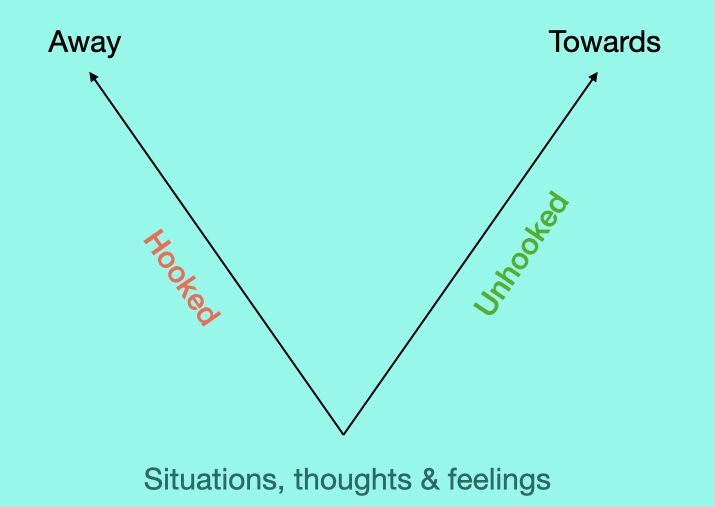
The automatic response for most of us is that when we encounter difficult situations, thoughts, and feelings, we tend to get hooked. Like in fishing, these difficult situations or internal experiences can hook us and pull us all over the place. The more tightly we are hooked by these things, the more likely we are to choose away moves.
And being hooked doesn’t mean you’re weak or flawed. It’s an automatic response for most of us because it’s part of being human—our brains are problem solving machines and when we encounter something difficult we want to get rid of it or fix it. This problem solving machine was essential for the survival of early humans. While it is sometimes still really helpful for us, most of the time it is not so helpful.
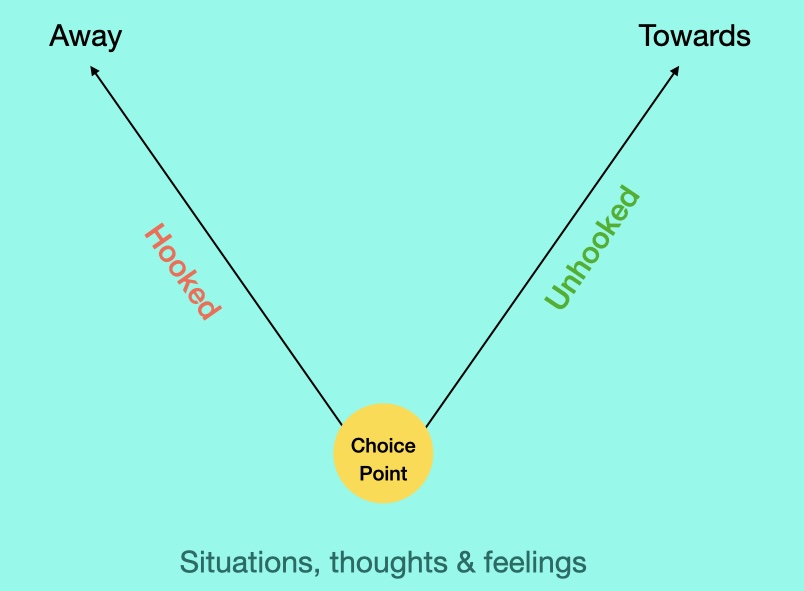
This is where the choice point comes in.
With any situation or internal experience that come up, we have a choice. Sometimes it’s really easy to make the toward move (e.g. your spouse slipped on ice and fell and you immediately run to their rescue to make sure they are ok). A lot of times it’s not so automatic. We all get hooked.
Fortunately, there are ways of learning to unhook from these difficult experiences. Improving our self awareness and ability to be present so that we are better able to catch ourselves when we notice the moment we’re hooked and begin acting in ways that are not aligned with our values (i.e. away moves). If you are interested in learning ways to unhook, reach out to me or another ACT therapist. There are also plenty of great ACT self help books and information online that can be helpful.
For right now though, I’d like you to keep the choice point in mind throughout your day. And when you catch yourself in an away move, remember, you are human—you’re not perfect. Once you identify an away move, you have a choice to alter your path.
 Mat Barbosa LMHC
Leave a comment